











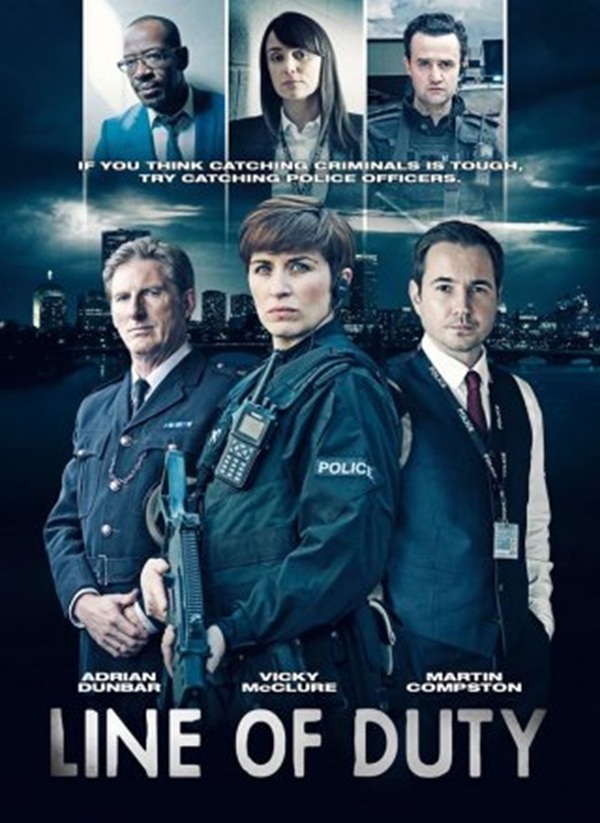
Among the great European television series of recent years, Line of Duty occupies a special place, because it reverses the conventional perspective of the police genre: while most crime dramas focus on investigators hunting down criminals, creator and screenwriter Jed Mercurio turns his attention to those who are supposed to uphold the law—the police themselves. The result is a thriller that transforms trust in institutions into unstable ground, where every certainty is destined to be called into question.
AC-12, the unit tasked with investigating police corruption, thus becomes the ideal laboratory for exploring the relationship between the individual and the system. Its protagonists are not merely fighting corrupt colleagues, but a bureaucratic and political mechanism capable of protecting itself through omissions, blackmail, compromises and manipulation. In Line of Duty, corruption is almost never the product of one individual’s wickedness: it is a systemic phenomenon, fuelled by perverse incentives, opaque hierarchies and mutual self-interest. It is the system itself that creates the conditions in which corruption is able to proliferate.
In this sense, the series engages with many of the anxieties of the new millennium. While works such as Mr. Robot depict the dominance of algorithms and digital capitalism, or Black Mirror, in its various incarnations, explores technology’s influence on perception, Line of Duty addresses another form of control: that exercised by institutions through administrative language, procedures and the management of information. The truth almost never coincides with the facts, but rather with the version of events that succeeds in prevailing in official reports, press conferences and chains of command. Power manifests itself first and foremost as control over the narrative.
The characters’ identities also inevitably end up being shaped by this constant tension. The officers of AC-12 try to remain faithful to their principles, but every investigation forces them to confront doubt, suspicion and compromise. The distinction between integrity and obedience becomes increasingly blurred, until the series’ fundamental question shifts from “Who is guilty?” to: is it possible to remain honest within a system that rewards silence and punishes those who upset its balance?
Mercurio constructs this argument through rigorous writing, built around gruelling interviews, procedural details and plot twists that are never gratuitous. The tension arises from the gradual dismantling of the viewer’s certainties, as we are continually invited to reconsider alliances, responsibilities and guilt. Each season broadens the picture, suggesting that behind every individual case lies a much wider network of relationships, one that is far more difficult to eradicate.
Line of Duty thus becomes a reflection on how institutions construct their own legitimacy, on the fragility of the boundary between maintaining order and defending power, and on how official communication can shape the collective perception of reality. In an age marked by a crisis of trust in authority and the increasing opacity of decision-making processes, the series demonstrates that the true antagonist is not the individual corrupt police officer, but a system that, while proclaiming transparency and legality, regards its own preservation as its absolute priority.