


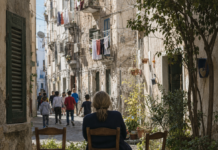









The timid February sun is already warming the early afternoon when, as she does every day, Sonia carries three chairs out into what she grandly calls her garden, though it is really no more than a smear of green between her front door and the pavement. Still, it is a luxury in the long, narrow alley where she has lived for almost half a century.
You cannot see the sea from her house, but you can sense it: in the scents carried on the wind, in the lapping of the waves that daytime noise conceals but the quiet of night reveals like a secret, in the colour of the skin of those who live by the sea and those who make their living from it.
Hers is a working-class neighbourhood where, over the decades, the local cadence has gradually mingled with foreign voices and accents. The names shouted from one side of the street to the other have changed, as have the smells, even the clothes. What has remained is that reserved, rough-edged, working-class solidarity that welcomed her fifty years ago.
“Auntie! Auntie! Can we have some sweets?”
The usual colourful, noisy group of children is making its way up the alley. The years pass, the children become teenagers and then adults, but the little group renews itself forever.
“One for you! One for you! One for you!”
Sonia hands out fruit jellies, which quickly disappear, earning her smiles, kisses and thanks.
She has neither children nor nieces and nephews, but everyone calls her “Auntie”, a title she inherited from Signora Caterina and of which she is very proud.
As she savours a blackberry jelly, her favourite, Sonia thinks back to when she first arrived in the neighbourhood: alone, homeless, penniless, unemployed, and frightened to death. She was thirty, and at that precise moment in her life she felt she had neither hope nor prospects.
She had found herself sitting at a table outside a shabby café and dairy bar: her legs had suddenly given way and she had almost collapsed into a chair to keep herself from falling to the ground, utterly exhausted. An old woman had emerged from the café with a nest of white curls on her head, a faded housecoat and a searching gaze which, Sonia would discover over the years that followed, never left her. She held a cigarette at the corner of her mouth, one eye narrowed against the smoke, and somehow managed to speak without letting it fall.
She asked Sonia what she wanted, and Sonia ordered a coffee. She had very little money left and needed to make every last coin stretch as far as possible, but she desperately needed the rest.
The old woman returned with the coffee—an excellent coffee—took a few coins and, instead of going back behind the counter, remained there staring at her.
“Trouble in love?”
“Excuse me?” Sonia asked, caught off guard.
“Sweetheart, you’ve got the face of someone with a broken heart. Either that or your cat’s died. Or you’ve been fired. Or an earthquake’s taken your house away.”
“Yes.”
“Yes what?”
“Everything.”
“Everything?”
“Everything you just said has happened to me. Except the cat, because I don’t have one. And except the earthquake. But I’ve lost my home, my job, and…”
“Your boyfriend.”
Sonia nodded, although boyfriend was hardly the right word for Gianni. Gianni was a husband.
Someone else’s.
She would have liked to close her eyes and sleep, curled up and hidden beneath a mountain of blankets, but she was sitting in a café, her coffee was finished, and the old woman seemed determined not to let her go. She began to feel uncomfortable and thought she ought to get up, but exhaustion pinned her to the chair.
“I’m looking for some help,” the old woman said unexpectedly, nodding towards a handwritten sign hanging in the window: Waitress wanted.
“I’ve never worked in a café…” Sonia replied wearily.
The old woman planted her fists on her hips.
“Can you clean a floor? Use a mop?”
“Yes.”
“Can you make a sandwich? Open a bottle? Make tea?”
“Yes.”
“Are you good with people?”
“I think so…”
“Can you smile? You wouldn’t think so, looking at you…”
Sonia parted her lips in a timid smile, and the old woman commented, “It’s a start. You can always improve.”
And before Sonia could reply, she made her an offer.
“One month. On trial. Proper contract. National pay rates. If it works, good; if it doesn’t, we go our separate ways. There’s a room behind the café with its own bathroom. You can stay there.”
A lump rose in Sonia’s throat. She was not accustomed to kindness from other people, and she remembered Blanche’s line at the end of A Streetcar Named Desire, one of her favourite films: …I have always depended on the kindness of strangers.
Unlike Blanche, she trusted no one, and just like Blanche, she had collected too many scars.
She bit her lower lip, then fiddled with the bracelet hanging from her left wrist, took a breath and gathered what little energy she had left.
“There’s something you’d better know.”
“Let’s hear it.”
She remained silent for a few more seconds, then forced the words out.
“Officially, I’m still registered as a man.”
The old woman did not stop studying her but, surprisingly, merely shifted the cigarette she had just lit to the other side of her mouth.
“I may be old,” she replied, “but I can still tell a woman from a man, even if you are very pretty and have delicate manners.”
She puffed out a cloud of smoke.
“Some are born women and some aren’t, but if you know you’re a woman, you become one.”
More smoke poured from her mouth. She looked like a chimney.
“I’m Caterina, but you can call me Auntie like everyone else does. So, what are you going to do? Take the job, or sit on that chair feeling sorry for yourself until the end of your days?”
The customers at Auntie’s Café quickly became accustomed to Sonia’s presence, while Sonia, for her part, managed within a reasonable amount of time to tame the infernal Cimbali coffee machine and serve good coffee and cappuccinos worthy of the name.
Caterina’s customers were like her: rough around the edges, discreet, good-natured. Every now and then someone made a stupid joke or became overly familiar in ways that made Sonia uncomfortable, but they were generally people just passing through and, with time, Sonia had learned not to let herself be hurt by those who could leave no mark on her life.
Every day, after the café closed—never later than eight in the evening—the two women had dinner together, and from time to time they revealed their wounds to each other.
In her youth, Caterina had experienced a great love, one that had deceived her and dragged her into a scandal that estranged her from her family.
“I should simply have been born fifty years later,” she would say with a hint of irony. “What was a sin yesterday is normal today.”
Tenacious and stubborn, she had worked like a mule until she was finally able to open her Bar della zia.
“No more bosses,” she liked to say, though it was never clear whether she meant at work or in matters of the heart. Over the years, she had grown close to her mother and siblings again, some of whom had made her an aunt in the literal sense.
Sonia, on the other hand, had been thrown out of her home at fifteen, when her parents discovered that her slender but male body concealed an entirely female identity. Alone and frightened, she had adapted to a life of uncertainty. She changed jobs frequently, usually working off the books for poor wages, and her constant moves had taught her to live with very little: all thirty years of her life fitted into two suitcases and a backpack.
Her relationships were always secret. No man had ever had the courage to love her openly, and when, many years later, she finally met a partner who asked her to live with him, she ran away.
She had spent almost fifty years hiding away, and she had neither enough strength nor enough desperation to want to change.
Friendships had been her safety net. By the time Caterina died, Sonia had long since taken over ownership of the café and had cared for her as devotedly as any daughter, if not more so.
“Why?” Sonia had asked her one day, while Caterina rested in a deckchair beneath the shade of the cherry tree. “Why did you help me when I first came here?”
Caterina had smiled.
“I was born in a seaside town, and at sea you always rescue shipwreck survivors. Always.”
The voices of her friends draw Sonia out of her memories. Elena and Maria are coming from the house opposite, carrying a tray with three little coffee cups, a moka pot fresh from the stove and a few biscuits. They walk slowly, with short, uncertain steps, careful not to fall. Elena leans on her walking stick; Maria keeps telling her to be careful.
They sit beside Sonia and enjoy the warmth of the sun.
“I’ve had a good life,” Sonia says, sipping her hot coffee, more to herself than to her friends.
“Yes. I really have had a good life.”