








Costanza invited us to the zoo on Saturday afternoon. Anne, the German girl with hearing problems who is in my care from Tuesday to Friday, decided to come down with a nasty fever at the beginning of the week, when the outing had originally been planned, and she’s still a little under the weather. Anne’s mother wasn’t terribly convinced by my friend’s idea. Costanza maintains that if you stay cooped up indoors too long when you’re ill, you’ll never get better: you need to get out and move around. But I’d spent the week changing sheets and rags covered in vomit, so I insisted.
“Let’s hope we’re not doing something fucking stupid,” I thought as I climbed the stairs to the girl’s room to get a jacket. I thought I’d said it to myself, but I must have said it out loud, because Anne’s father, who works at the German Embassy and never swears, poked his head out of his study and clicked his tongue, his eyes sparkling with shock and amusement at the same time.
Costanza came to pick us up in her old Fiat Panda Active, with a portable radio tucked into the side compartment instead of a stereo. As soon as we’d settled in, trying not to sit on the empty crisp packets and grease stains scattered across the worn fabric of the seats, she repeated that a little fresh air could only do a convalescent child good.
It’s a beautiful day, with blue skies and sunlight on the brick walls of the buildings we leave rapidly behind us. As soon as we drive into the zoo car park, I can’t help noticing the roses reflected in the mirrored sphere at the centre of the circular lawn around which the entrance road runs. The paths at the beginning of the park are lined with borders of plants and new shoots: it looks like an enormous flower show.
At first Anne, although she seemed listless and out of sorts and had repeatedly demonstrated her precarious state of health on the journey with long, frequent sneezes, becomes excited and is now hopping about, displaying an extensive vocabulary of more or less intelligible sounds: “Ehehanhe!” (elephant), “Hihia!” (monkey), “Hoho!” (bear). I hold her hand while Costanza circles around us, pointing out this or that about the animals. We’re near Monkey Mountain, a large island of rocks in the middle of a sort of pond with waterfalls.
I’m holding Anne’s hand tightly when I notice something about the monkeys that catches my attention.
“Look, Costanza!” I say, and let go of Anne’s hand to point at a monkey and explain what I mean.
When I reach out again to take her hand, I discover that she isn’t there.
With her, it’s as though I’m on autopilot: my hand and hers always find each other again a few seconds after they separate. When I don’t feel her hand, I look down.
“Anne!” I shout.
Then Costanza starts shouting too.
“Where’s Anne?” we keep yelling at each other.
We’re rooted to the spot, turning our heads in every direction. There are so many people, but she isn’t among them.
“Try to stay calm,” Costanza says, but I’m on the verge of feeling sick. I know perfectly well that Anne seems to have no fear of death, always lost in one of her daydreams. If it occurs to her to run across the road, she does it without looking right or left. It’s happened before. A few months ago she dashed into the middle of an intersection, causing a chain of cars to slam on their brakes and a couple of rear-end collisions; every car started honking, creating a hellish racket.
So no, I can’t stay calm.
“Let’s split up,” Costanza suggests. “Meet back here in fifteen minutes, whether we’ve found her or not.”
We separate, shouting “Anne!” even though we both know perfectly well it won’t do any good.
I run from one person to another, asking, “Have you seen a little girl dressed in pink, with braids and a hearing aid?” I accost one group after another in a frenzy, interrupting dozens of conversations and getting nothing in return but blank or irritated looks.
A quarter of an hour later we meet back where we started, both of us without Anne. We decide to search in ever-widening circles and meet again half an hour later; if we still haven’t found her, we’ll go to the zoo staff.
Formulating the question, “Have you seen a little girl dressed in pink, with braids and a hearing aid?” takes time, and I repeat it over and over and over again. The crowd seems to be getting thicker, and at the agreed time, when Costanza arrives with a member of staff, we’re told they can’t make an announcement because the public-address system has been out of order since that morning.
“Have you seen a little girl dressed in pink with braids, have you seen a little girl with braids, a little girl dressed in pink?”
I’m sweating on this beautiful, hot day.
A girl in pink?
People take forever to answer, giving me hope.
Then nothing.
“Oh yes, of course! That way! There are lots of little girls dressed in pink.”
“But a little girl dressed in pink, with braids and a hearing aid?”
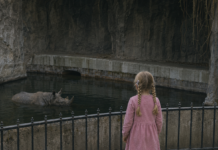
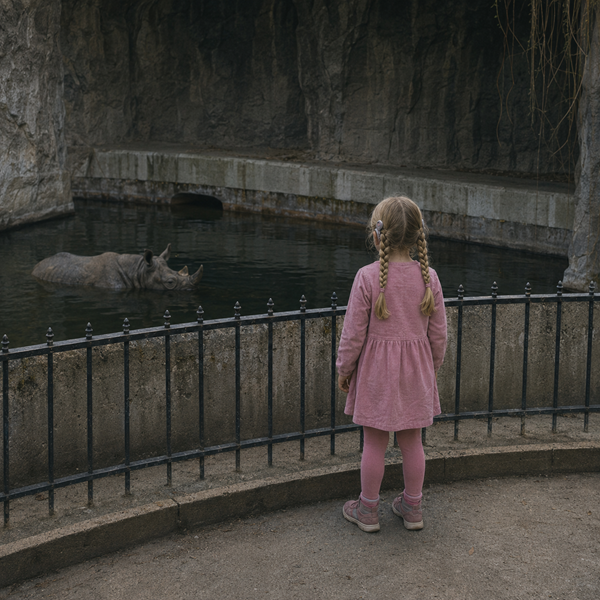
It’s cool inside the rhino house. Dark. Quiet. No crowds, just a handful of people. It’s an artificial cave enclosing a large expanse of water, a lake surrounded by steep concrete walls, a slippery, slime-covered pit where two-ton animals with pointed horns drift lazily in the water. A wrought-iron railing runs all the way around it.
On the opposite side of the lake there’s no one except a little girl dressed in pink, with braids and a hearing aid.
Climbing over the wrought-iron railing.
“No!” I scream.
For an instant I close my eyes and see blood on the ground, her shattered body.
“Anne, no!”
I start running as fast as I can. By the time I’m only a quarter of the way there, she’s crawling onto the top edge of the wall.
I squeeze my eyes shut and shake my head.
“Stop!” I keep shouting, though I know it’s completely useless.
She looks confused, searching for somewhere to put her foot. There isn’t anywhere, because the concrete wall on the inside drops sheer to the bottom. Anne is already over the railing, one foot on the solid ledge surrounding the water and the other reaching out into empty space.
I reach her at the exact moment she loses her balance and hangs suspended in the air, one hand slipping as she desperately tries to grab hold of something that isn’t there.
I lean over the railing and seize her by one arm, holding on tightly. Reaching down from above, I grab the other one too. No matter how hard I try to pull her towards me, I can’t lift her. I don’t let go. I keep hauling her towards me while she struggles, disoriented.
At last I manage to lift her over the railing and hold her in my arms.
“Anne!” I say, but she doesn’t react.
I hold her even tighter, but her eyes are absent. No response. I shake her gently. She’s pale, her eyes vacant. I keep holding her close.
It’s as though she’s surrounded by fog. She doesn’t respond to anything.
Outside, the light is dazzling. I clutch Anne in my arms and run like mad. My eyes burn and I feel the tears streaming down my face, gathering at the base of my nose and dripping onto my lips.
I keep running while the people around us stare.
Costanza and I were supposed to meet at Monkey Mountain, but when we get there, there’s no one.
Only strangers, me, and a girl in pink looking calmly around her with complete indifference.