















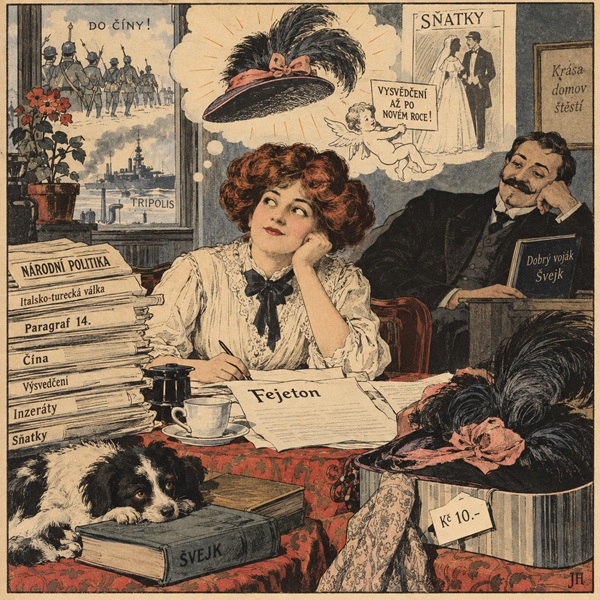
Machar will surely forgive me if I steal a tiny sentence from him. In any case, I hope he will never find out; and even if he does, I trust he will not soil his hands over a few little words.
Since no newspaper has yet managed to tell me what a feuilleton actually is, I decided to try writing one myself. Something one can read in the morning over breakfast, while still yawning, and in the afternoon, while lounging blissfully after lunch on a soft sofa. The sort of thing in which you can skip half a column without missing anything.
Míťuška laughed at me, because he has no very high opinion of my abilities where literature is concerned. It is also partly revenge because I refuse to kneel in sacred reverence before his “Good Soldier Švejk.” It is his first book, which is why he is so terribly conceited about it. He wanders around me, coughing discreetly and chuckling, the wretch, asking whether I have started taking politics for a ride yet. Not yet, my dear, but I shall begin at once.
I do read political editorials, though only when I am in a particularly desperate mood; and I have been in precisely such a mood for the past fortnight, which is exactly how long I have been thinking about that coquettish little hat I saw—but he knows perfectly well where I saw it, because I tell him a thousand times a day. Unfortunately, he is a cynic who listens to my odes on the beauty of that dream hat with exactly the same smile with which he reads reports about the Italo-Turkish War. “I’ve never seen such a beautiful one in my life—the cable between Rhodes and Lemnos has been cut by the Italians—it has skunk fur all around it—relations between Italy and Austria are extremely strained—I could wear it for two winters—the enemy forces have withdrawn from Gharian and Assyria, where cholera is raging—” all of this passes through his brain without his paying the slightest attention to any of it.
So I read political editorials, and if Count Stürgkh thinks that Section 14 is going to make any impression on me, he is very much mistaken. Let him finally get that military law passed. The more men you conscript, the better for us. At least those boys will learn obedience in the army. Once they marry, their wives will have struck gold. It is the greatest service the state can render to women.
Unfortunately, in my case the state has behaved like a stepfather. Míťa went up for conscription four times and they never took him. And so I have to make up for the entire education he missed at the hands of corporals, old army dogs, officers, colonels and so forth, and instil in him the beautiful principles of obedience, modesty and diligence. It is, however, a task of extraordinary magnitude. About as easy as sending a regiment of North American infantry to intervene in China.
For that matter, I wish that regiment, and the two British battalions which are supposedly coming from India to China, every success, because the Chinese are a cruel people. All readers, and especially the lady readers of Národní politika, will surely remember the abominations those Chinese committed against beautiful Evelina and poor Janina in the recently published novel The Mysterious City. Just imagine what they must get up to over there, at home in Peking, if they dared do such things in Stonehouse itself. Of course, we are told that sending American troops to China has no political significance. I am quite happy to believe it. The only question is whether the Chinese believe it too.
Yesterday Míla, my little cousin, reminded me that Christmas will soon be here. And school reports as well. There is so much talk about that mighty Section 14. The bad reputation of this section—of which, incidentally, I have only the vaguest notion—could surely be splendidly redeemed by one great and humane deed, if Count Stürgkh were to use it to postpone school reports until after New Year. Millions of pure and innocent souls would bless him. For handing out school reports before Christmas presents is something so refined in its cruelty, so dreadful, that one could almost believe the institution dates from the Middle Ages. God forbid, however, that our illustrious government should imagine I am trying to order it about. I merely mention the matter, most respectfully.
Míťa, the scoundrel, claims he can see five tongues of fire above my head. He doubts, however, that they will do me much good. Remarks of that sort will certainly not knock the pen from my hand. For I am not driven to write by any thirst for laurels, but by feminine greed: by the hope that the illustrious editorial staff, in its mercy, will publish my feuilleton and thus help me attain the object of my fortnight-long desire—that velvet poem cascading into long ostrich-feather fringes, for which I lack only a miserable ten crowns.
For the greatest, and almost the only, desire of a woman is—and this is a great truth which I am stealing from no one; after all, five tongues of fire have descended upon me—to please herself. And I should so dearly like to please myself. Míťa says I already please him more than enough, but that is male politics. One can see through that at least as clearly as through those Italian victories around Tripoli.
Every day I read the matrimonial advertisements. It warms my heart to know that we have so many girls from good families, modest young women without dowries, capable businessmen and intelligent sausage-makers. One might say that all the virtues of the nation rise before the reader’s eyes in the full vigour of life and in radiant nakedness.
We see that our girls are well brought up, refined, noble, quiet, gentle and thrifty, that they long for a cosy home, and that they intend to bestow the blessings of all these first-rate qualities upon a man even if he is old and unattractive, or perhaps a widower, provided only that he has a secure position. “Which gentleman is seeking not a fortune, but a pretty, educated and good little wife?” asks one modest advertiser. An energetic, intelligent, young and handsome man, however, seeks only a girl with a substantial fortune—or a business into which he might conveniently marry. And so the two of them will probably never meet beside that “warm hearth” for which they both yearn.
And this saddens and troubles me. I am troubled, too, on behalf of the intelligent young maidservant who wishes, by this means, to make the acquaintance of a teacher or civil servant with matrimony in view. I am simply the sort of creature who worries more about everyone else than about herself. Though apparently there is nothing unusual about that in a woman. Everybody reproaches us for it. Every man likes to have a go. We are said to be gossipy, quarrelsome, malicious, vain and lazy.
Which is why no man has anything better to do than fall in love with us and marry us. Birds of a feather flock together.
“Of course you’re not one whit better than I am, Míťuška, and in any case you’d do better to get some work done instead of constantly peering over my shoulder. Your precious brain might get scorched on my tongues of fire, do you understand? Not that it would be such a terrible loss, you Švejk!”
It seems to me that I have written quite a good feuilleton: something one can read in the morning while still yawning, and in the afternoon while lounging blissfully on a soft sofa. The sort of thing in which one can skip half a column without missing anything.
Now I know perfectly well what a feuilleton is. I can feel it, because writing one has given me a pain in the back. But this much I will say: if Machar, when he looks at his Rome, feels the same way I do when I look at my feuilleton, then he must certainly have a very high opinion of himself.